Carry on Cwtching

This article first appeared in the June/July 2012 issue Red Pepper magazine.

In January, a fledgling community group opened the first in a series of squatted social centres in Swansea. Naming themselves Cwtch, the Welsh word for cuddle, most of the group met during Swansea’s Occupy protests, but from day one they were a movement in their own right.

‘Not everyone in Occupy Swansea wanted to do a social centre,’ recalls 57-year-old activist D Murphy. ‘So we kind of split our meetings into two: we would have an Occupy meeting and then people would drift away and talk about the social centre.’

They began by squatting the abandoned Dolphin hotel in the city centre, after gaining access through an open window. Just one day later they’d transformed the 66-room hotel into the Cwtch Community Centre. There was a donations-optional café, a freeshop and room to relax and hold workshops.

Cwtch has found strength in the variety of people involved. ‘There’s one local businessman who was there from the beginning. There’s a university lecturer and I’m an office manager . . . I’ve made a wonderful new friend who’s 17; it’s cut across all kinds of boundaries,’ says D.

Cwtch has keenly promoted the centre via its own videos, on Facebook and in the mainstream media too. Its transparency has helped attract a diverse range of Swansea residents. At the Dolphin hotel many different people could be found enjoying a cup of tea, or browsing the library, including young families and homeless people.

Homelessness is a serious problem in Swansea. More than 15,000 people sought council help for homelessness in Wales during 2011, up 11 per cent on the previous year. The highest number of homeless as a percentage of the population is in Swansea.

Cwtch’s aim has been not just to provide shelter for the homeless but to highlight the lack of provision for homeless people. ‘Considering the wealth of finance we’re supposedly stopping by running a free arts café, you’d think they could provide more than a single emergency bed for the homeless of Swansea,’ comments Rev, another member of the organising group.

The hotel’s leaseholder, UBS, acted quickly and an interim possession order was obtained, bringing the group to court on Valentine’s Day. D says the courts were surprisingly sympathetic: ‘When he [the judge] was handing down [the verdict] he said if he had any discretion in the matter he might have come to a different decision’…

Read the rest at the Red Pepper website.

Jess Bryant // Silvern // Album // Red Deer Club // 09.08.12

This article originally appeared on Never Enough Notes on 10 July 2012.

‘Dark cinematic folk’ is how Jess Bryant’s music is described on her Twitter page. Cinematic certainly is an apt description but it’s hard to pigeon hole the orchestral ‘Silvern’, which could be labelled as much with the broad brush of indie as with classical, folk and jazz in differing places.

Musically Bryant’s classical influences are clear and also a love of the glockenspiel, which appears nearly in every song. Apparently she is also influenced by writers like Paul Auster and Haruki Murakami who both focus on absurdism and surrealism…

Read the rest of the review here at Never Enough Notes.

Somewhere to_ show off in Cardiff

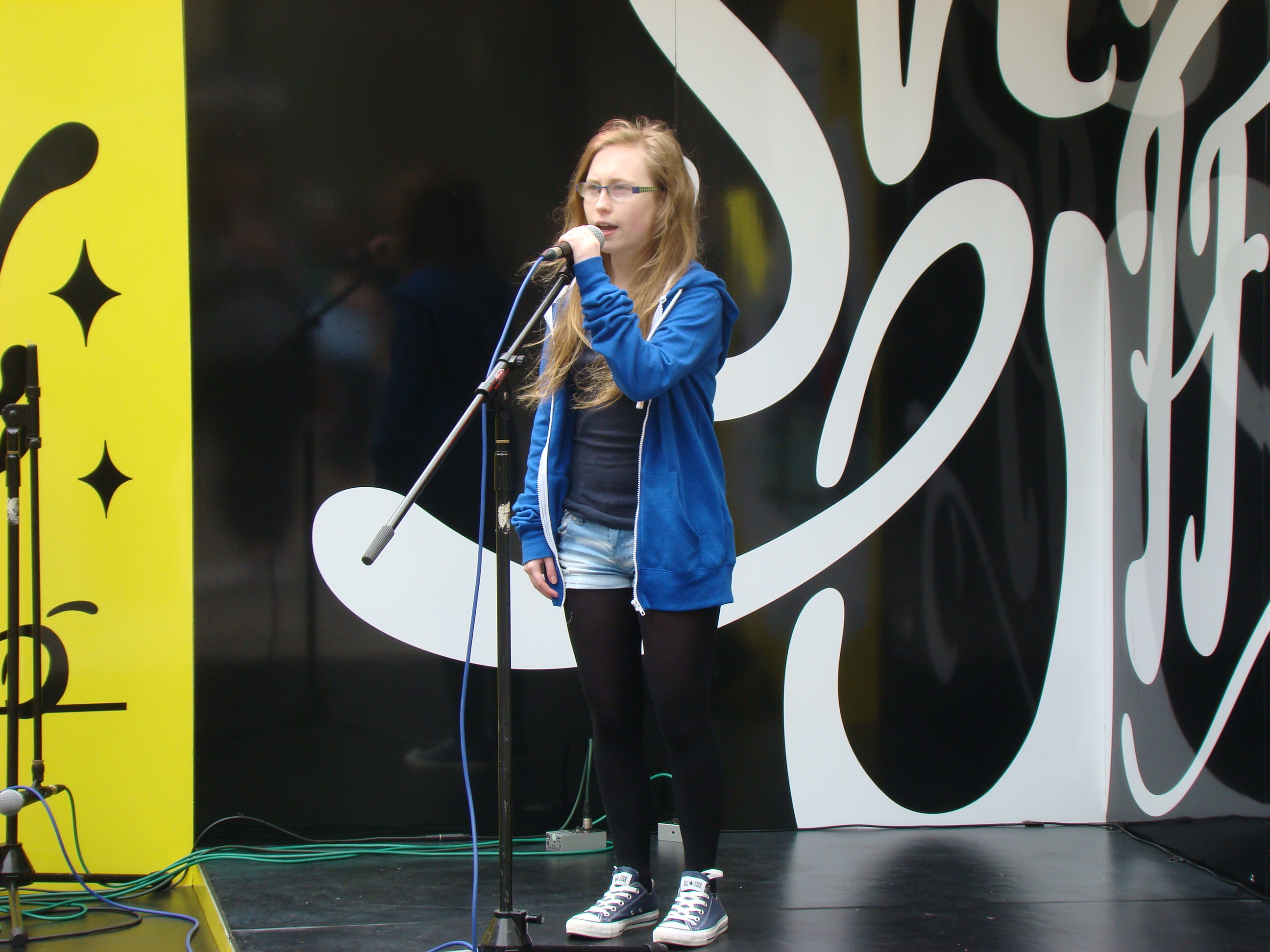
Checking out Cardiff’s young talent with somewhere_to in The Hayes, Cardiff city centre, on Tuesday…

Shannon gets recruited to sing

Empty buildings frustrate me, and it’s getting more common. While thousands of people are in need of housing, or community space, loads of it is being wasted, or hoarded. Squatted community centres like the Red and Black Umbrella, here in Cardiff, are one way people tackle this from the grassroots. There are also emerging projects like Capacity Bristolwhich aims to “legitimatise the temporary usage of space by artists.”

Fluidity Freerun

Fluidity Freerun

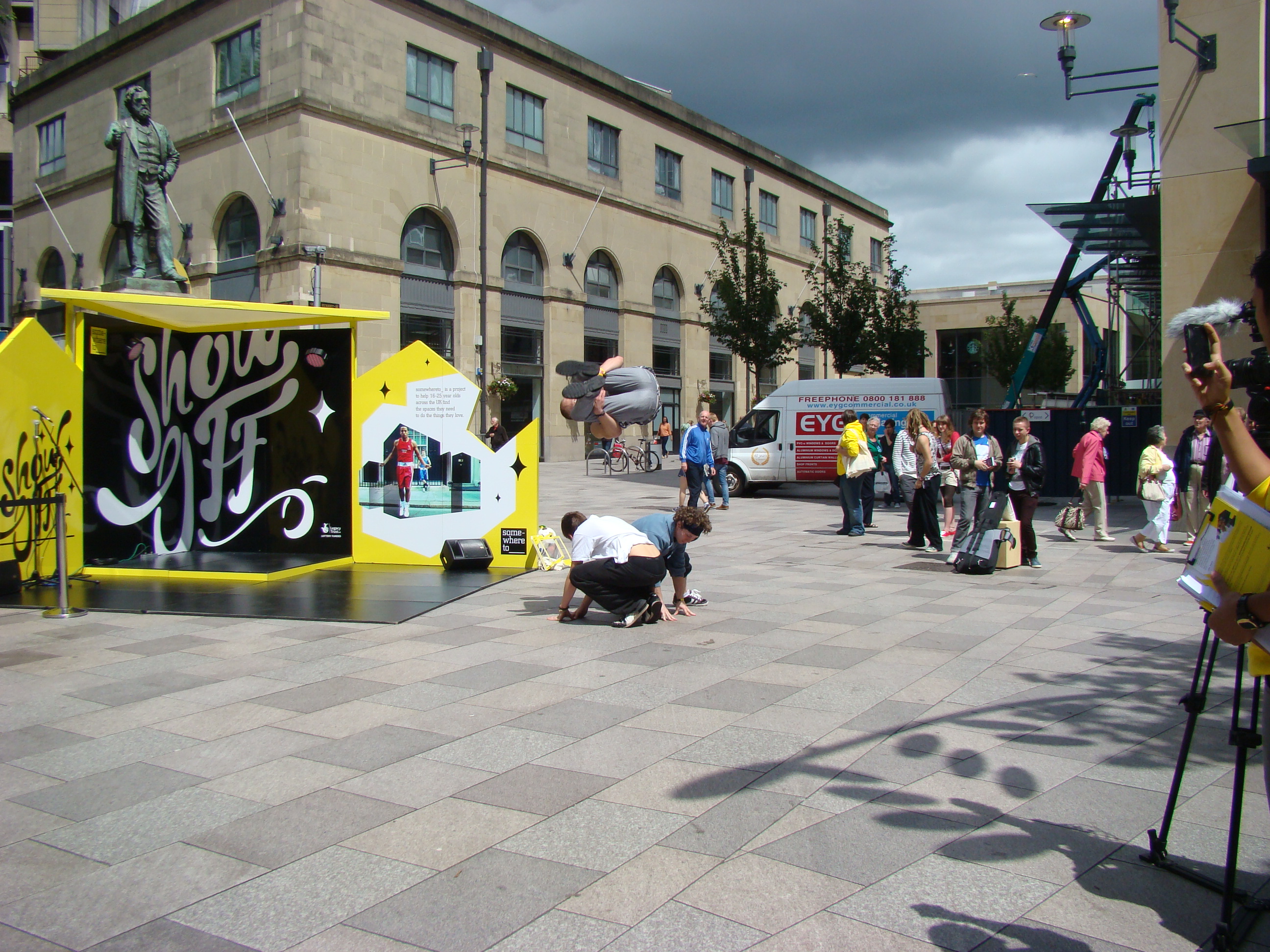
Livity, the “socially responsible communications” people, are doing things their way with somewhereto_, along with Channel 4 and the Legacy Trust. The aim is to match 16 to 25 year olds up with space they’ve been looking for to do anything from singing to running a community group or practising gymnastics.

Cardiff’s somewhereto_show off leg started off very quiet; no background music and no performers, but things eventually kicked off with Lloyd Daniels (he’s off X Factor) who did two covers. After that things were pretty much back-to-back with some performers who had been pre lined-up to play and some who had volunteered off the street, with a crowd gathering for each one.

Ffion impressed with her voice

Performances were singer heavy, not quite the crazy array of Britain’s Got Talent style acts I was hoping for, but people like funky duo Twelve Strings and Ffion Edwards, who had to convince the Livity people that she was actually 16, and not younger, blew everyone away. Sam Hickman, the Joanna Newsom-esque harp player and singer covered Paloma Faith – she’s one of my favourite Cardiff buskers, locals can check her out singing near the Owain Glyndwr. For the boys, Shannon and Russell Jonesbrought out the retro rat pack voices, despite their fresh faces.

Nathan Mizra

Fluidity Freerun satisfied my craving for acrobatics with their impressive parkour, Saeed brought out his motorbike noise impressions and Nathan Mizra did a touching but short spoken word performance. Other performances included the terribly named Ladies Love a Superherowho were a bit like a McFly for 2012 and gave Llyod Daniels a good run for his money singing wise. Didn’t get asked to have as many photos with teenage girls thought and sign as many flyers, all in good time though.

Hopefully this competition will go some way to raising awareness about somewhereto_ and underused space in general, and be more than just another talent show.

Cardiff was the last date of the tour but you can still submit video entries online until 16 July 2012.

Celebrating Cardiff’s women

Last Saturday at a craftivism workshop in Cardiff I met Sara Huws and something she mentioned got me thinking: Where are all the statues of women in Cardiff?

If you know Cardiff your thoughts will automatically snap to statues like Mother and Son on Queen Street, or maybe Nereid on Kingsway. Statues like these were pointed out by fellow workshop attendees but none of us could name them as people; they are all nameless women representing an aspect of womanhood or some kind of character or concept.

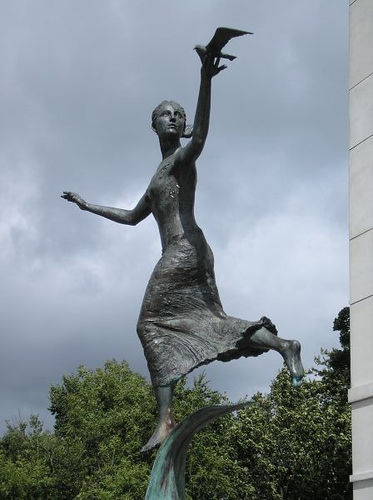
Nereid

Nereid by Nathan David

Sara wrote a blog post on this in 2011:

“I’d rather be proven wrong about this, but it really does look like every female body represented in public sculpture around Cardiff is symbolic (every! single! one!). They fall into the following general categories: angel, goddess, virtue, caryatid, figurehead, mother and wife. Possibly mermaid.”

In her post titled A Modest Proposal: A Statue of an Actual Woman for Cardiff, she explains her quest for, “a public sculpture in Cardiff of an actual female person, living or dead, whose name I could Google.” She wrote:

“In a frankly super-retro twist on an ole’ Victorian classic; women’s bodies and what they represent are abundant in Cardiff, but not their stories, identities and voices. The ‘seen and not heard’ female slips unnoticed into the civic background of the city.”

I was pretty surprised that the capital city of Wales, a place full of strong women and a city that often celebrates its diverse past and present would have been able to find many women to dedicate statues to.

It could be argued that nobody deserves a statue, that behind every great politician, scientist artist of sportsperson there is a number of great people contributing just as much, if not more, to their community and the world. But it’s a shame that the public face of Cardiff while finding it within itself to dedicate statues to men like Aeurin Bevan, Jim Driscoll and Ivor Novello, all just as deserving as Cardiff and Wales’s well known women who have not been given the same kind of celebration. After all, if they are not celebrated and given the same public respect as men what hope is there for the rest of us?

The original post was a while ago now, July 2011, but Sara is still interested in Cardiff’s missing woman statues. She has said she’ll be researching women’s stories and posting about them as she goes as well as conducting a poll.

So here’s my suggestions (and yes, I think nominations can be dead or alive, and I admit I don’t have a great knowledge of history):
Shirley Bassey – Sara’s prediction of the poll winner
Tanni Grey-Thompson – Possibly one of Wales’ most well known sportswomen
Gillian Clarke – poet, playwright and many other things, also figures in many G.C.S.E and A Level English anthologies and course work

Who would you like to see a Cardiff statue for?

Read Sara’s full post on her blog Boglyn, here.

Thanks to David Reeves for the photo.

In the Observer today

An article I worked on with Denis Campbell while on placement at the Guardian earlier this month was in the Observer today, which is exciting; my first joint byline in the paper. It’s about the contraceptive coil (IUDs) and problems with fitting, you can read the article here.

Are quotas the answer?

This was originally written as a university assignment and aimed at  Press Gazette.

Hundreds of  journalists in Germany have called for gender quotas in top media jobs. Women in the UK media give their opinion on whether we should be calling for the same here…

Rebekah Brooks and Sly Bailey: both high profile, both women, and both out of the job. Whatever your opinion on them, they were part of a very small group of women in the industry who make it to the top of their game.

The lack of women in powerful media positions is not just a UK problem. In February, in a letter sent to around 250 editors, publishers and managers across Germany,  journalists called for quotas to get 30% women in executive jobs in editorial departments within the next five years.

Quotas have been in the news recently in Britain in the context of business but the issue has not been seriously raised here in relation to the media. When suggested in any sector they are controversial but are they the only way to equality?

What limited research there has been into the amounts of women in the UK, and global, media workforce has shown that despite high numbers of women entering the industry they are not working their way up the career ladder.

In 2011 the International Women’s Media Foundation (IWMF) released the Global Report on the Status of Women in the News Media. Covering 170,000 people they found that 73% of the top management jobs globally are occupied by men.

Looking at 16 news companies in the UK across newspapers, television and radio the IWMF found that although women represented 45% of the combined workforce, at senior management level the proportion of women was 29.5%. The UK companies studied, “exhibit entrenched institutional practices of marginalising women in their newsrooms and decision-making hierarchies.”

The trend is similar across media platforms. The Fawcett Society carried out research in 2007 which showed two woman editors out of the 17 national newspapers surveyed. If the study were to be done again today this would be just one, Tina Weaver of the Sunday Mirror. Rebekah Wade (now Brooks) was replaced by a man when she left The Sun to become chief executive of News International. The 2007 also showed 6% women among deputy editors at nationals.

In 2011 Skillset released research into the UK broadcasting industry that said that while women working in radio were better qualified than men (73% had degrees compare to 70% of men), they earned, on average £2,200 less each year. They were also just 34% of senior managers and only 17% at Board level. In television the numbers at board level were 29%.

Dr Cynthia Carter, of Cardiff University, is a leading academic in gender and the media and founding co-editor of the Feminist Media Studies journal. She says there needs to be more research done into why women are not progressing. “A lot of the top jobs need 24/7 availability,” she explains. “As women get into their 30s they start having issues with partners and children and start taking positions that don’t lead to the top jobs to allow them to have a life outside work.”

In Skillset’s research only 16% of women in UK radio had dependent children compared to 25% of men. A report on the film industry commissioned by the UK Film Council, published in 2007, echoed this saying 36% of men lived with dependent children whereas only 14% of women did.

Janet Street-Porter raised the issue in the 1997 documentary A Night In With The Girls saying society still expects women to fill a role. She said women needed time to themselves when they get home from work to “stop being a boss woman and become a normal person.” She suggested men are used to being bossy all the time.

Francesca Preece, editorial assistant at The Sun, says that women in journalism have to fight their corner. “It takes a very strong woman to break through the prejudice. If you had two equally qualified young people, one male and one female, the male journo would almost definitely be taken more seriously,” she explains.

The main argument for the introduction of gender quotas in the UK media follows that although change is happening it’s not happening quickly or thoroughly enough. People recruit in their own image, and will continue to do so until someone shakes things up. Dr Carter describes this as informal and unconscious discrimination where men often see themselves in a candidate of the same gender and similar background.

It is argued that quotas are compensating for the barriers a particular group faces and that as audiences do not get to choose who runs the media so they deserve a more representative workforce to better cater to their needs.

Quota Project, a database of gender quotas for women, use Norway as one of the examples they say prove quotas work. A law was passed there in 2003 to allocate 40% of boardroom places in publicly traded companies to women. There are now have 37.9% women on company boards whereas the UK has 12.5%.

But those people against quotas see them as patronising, elevating people to positions they are not skilled or ready for. “Hiring more women at the expense of men for example won’t make male journos respect them any more than before…They would just be seen as filling a quota and not there on merit.” says Preece.

“If Rebekah Brooks managed it without a quota at one of the most male dominated titles, I am sure many others can elsewhere in Fleet Street.”

Do we need gender quotas in the UK? Journalists Alison Clarke and Michelle Perry go head to head.

Yes

Authour and journalist Alison Clarke is the founder and co-editor of Women’s Views On News.

“Quotas are a bit of a sledgehammer to crack a nut but where they have been introduced, in boardrooms and parliamentary representation, they do make a difference…Quotas serve a purpose and they should be time limited so it’s not that they’re on the statute book forever.

“I’m 57 and I’ve heard that argument [that we should wait for change] for 30 years. Well, I’ll be dead before it does; it’s nonsense. It won’t happen because we all hire in our image.

“The UK media industry is not just dominated by men at the top, but when you drill all the way down then newsrooms are dominated by men as a result of which our news is filtered through that male lens. They’re deciding who should be heard and who shouldn’t be heard.

“One woman is never enough they reckon you need about 30% so you have a critical mass then things start to change, so you get a critical mass with parliament, suddenly parliament starts talking about childcare, maternity rights, lots of issues which are of more direct relevance to woman and I think the same thing would happen in the newspaper industry.”

“I would say that most women who work within that industry know that it’s very male dominated but if you asked an awful lot of men they wouldn’t necessarily be aware of that. Or if they were they wouldn’t be aware of the impact that it has on women in terms of the culture.

“People on the right argue against it because they say it’s tokenistic and that they don’t want to be a token woman and that they want to get there on their own merit. My argument would be that there are plenty of women out there with plenty of talent and there’s a reason they’re not getting on and it’s got nothing to do with their ability.”

No

Michelle Perry is a journalist specialising in business and finance. She is the editor of CFO World a website for chief financial officers.

“I personally wouldn’t back any quotas in any industry, for any reason. What I’ve seen in business the threat of quotas is enough to make people make change. People don’t like change whether they’re a man or woman and they especially don’t like being told to do it from outsiders.

“Even though journalism is predominately populated by men it is changing and in the younger ranks coming through now there’s probably a greater balance of men and women. Personally I’ve always worked with male bosses and with a majority of men on news desks and I’ve never felt it’s a problem and I’ve never felt that I was inhibited from progressing in my role.

“I think it [the workplace] is changing because more and more women are in the workplace and want to go back to work after they’ve had kids. I think more organisations now realize that they have to have flexible structures to incorporate this very talented workforce that is being excluded.

“Someone should do an industry piece of research then we can see who’s in all levels, then if there is a problem you can work from facts and not presumption. Perhaps it won’t change unless it’s raised and we just carry on plugging along and perhaps women don’t rise up and leave the workforce and don’t vocalise why they are. I think there’s also an issue that women tend to be not as bolshie as men and perhaps wouldn’t go for the roles that they don’t feel confident about.

“I find that if you kind of force the situation then you end up getting people into positions who perhaps aren’t ready. Not because they don’t have the skills or they don’t have the ability to get the skills, but because they haven’t had the experience…they may fail and that will be a disservice to all of us.”

How to…give your cocktail a green-over

This article first appeared in the Ecologist on 8 May 2012.

Shaken or stirred, recreating the bar experience at home is becoming ever more popular as the economic downturn makes staying in the new going out. But staying in doesn’t necessarily mean green. The Waste and Resources Action Programme (WRAP) estimates that the carbon footprint of alcohol consumed in the UK is 1.5 per cent of the UK’s total greenhouse gas emissions. The life cycle of the product adds to this and needs to be considered when making the green choice.

One of the easiest ways to go green is to go organic. Chris Parker is the owner of the Surrey-based Organic Spirits Company. ‘Normal fertilisers contain a mixture of natural phosphates, which are gradually running out,’ he says. ‘There’s also nitrates which, in terms of pollution, give off nitrous oxide which is 300 times as toxic as carbon dioxide.’ Dr Paul Taylor is a Carbon Trust advisor who specialises in food and drink. He agrees that farming practices are important. ‘If there’s an agricultural component they need to be careful of not using too many fertilisers,’ he says. Parker says that, after winning 36 international medals, the proof of the Organic Spirits Company’s product is in the drinking. ‘Independent judges who are blind tasting have been picking out our products against the world’s best,’ he says. Fans of organic cocktails say they taste smoother and fresher…

Read the full article here at the Ecologist.

April: the month of interning

For the last five weeks I’ve been doing work experience at the Ecologist and the SocietyGuardian

Since the beginning of April I’ve been sofa surfing my way around London (and Surrey), staying with lovely friends and family, and getting a lot of use out of my A to Z.

The first four weeks were at the Ecologist, an environmental online magazine. It was great to be somewhere with such a history in the environmental movement and properly get stuck in to some interesting topics that I really care about. Interns at the Ecologist tend to be tasked with writing a lot of lifestyle articles for the Green Living section, something I haven’t done a huge amount of before but I really enjoyed getting into something different while still writing about things I cared about. I also had some really helpful expert interviewees (and editors) to help me out. I will be posting links to all the articles I wrote here as they are published on the site.

For my final week I was back at the SocietyGuardian (I was there for two days in September) it was again great to get stuck into researching some really important issues. One of my main tasks was working on these interviews for a piece two years on from the launch of the ‘big society’, tracking down some of the people who went to the high profile meeting at Downing Street to find out what they thought now with some interesting responses.

I was really lucky with both my placements, working with welcoming and friendly teams in both places, and at the Ecologist my fellow interns Rachael, Mark and Lisa.

Now it’s back to one month more of uni, deadlines, exams and then in June out into the ‘real world’ again.

The dark side of soya: how one supercrop lost its way

This article was first published in the Ecologist on 1 May 2012.

Once credited with power to prevent cancer and combat high cholesterol, over the last few years, evidence that soya is far from a superfood has begun to emerge. And it’s not just the potentially negative health impact of the bean that has former supporters up in arms: it’s the environmental impact. In the UK we rely heavily on soya, or soy, and it’s not just for vegetarian food. It is a hidden product in many foods and everyday items such as soap. It is a cheap source of protein for people as well as animals and according toGreenpeace, 80 per cent of soya worldwide is used for the livestock industry.  WWF add that the UK consumption alone requires an area the size of Yorkshire to be planted with soya every year. So how did soya go from super crop to super bad?

Deforestation and slavery

Brazil, the second biggest grower and the biggest exporter of soya, is such a big player in the industry that there are major concerns about how this is affecting the Amazon Rainforest. According to Greenpeace, in 2005 around 1.2 million hectares of soya was planted in the Brazilian rainforest. Sarah Shoaka from Greenpeace’s Forest Network says that deforestation has been decreasing on the whole in Brazil since 2008. This is mainly because of the enforcement of a soya moratorium that bans soya produced as a result of deforestation from entering the market place.  However, Shoraka warns that this positive trend may be changing…

Read the full article here at the Ecologist.