UpStart

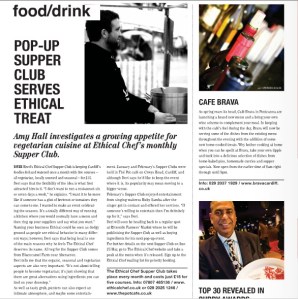
At the moment I’m part of a team of 14 people working on a new magazine called UpStart which is part of our Postgraduate Diploma course.

UpStart is aimed at the UK startup community, hoping to provide something more useful, interesting and relevant to people who have small businesses than traditional business media which tends to cater for bigger, less creative, higher turnover businesses. We want to speak to the people working for themselves, either on their own or in a small team, avoiding the ‘men in suits’ image of the business media. People who don’t so much see themselves as businesswomen and businessmen but people who have their own businesses.

Currently we are working on issue two of the magazine but you can see issue one here on Issuu, any feedback gratefully received.

The UpStart website is here.

Belleruche // Stormbird // 05.03.12 // Tru Thoughts

First appeared on Never Enough Notes on February 16 2012

Belleruche have seemingly joined the campaign to bring 1980s style electro back once and for all. But they don’t always play this way, with experimental, hip-hop and soul fusion being their usual shtick. The trio formed in London and have been knocking around since 2005 and have released three albums. Their LP ‘Rollerchain’ is due for release in May and will set the scene for this new, darker and broodier sound.

Latest single ‘Stormbird’, out on 5th March, starts with a rhythmic tempo, marching along in an eerie way with continuous whining keyboard and guitar in the background. Getting faster and faster towards the end, it is repetitive in a good way and sticks in the mind as does Kathrin deBoer’s voice. Sweet, sultry and smoky. Then all of a sudden, after less than three minutes, it’s over. And I want to listen to it again.

9/10

Phone hacking, journalism ethics and the digital revolution

This article was originally written in answer to the question below for an assignment at university in January 2012.

Does the phone hacking scandal show that good journalism will be the first casualty of the digital revolution in the media?

Journalism is dying, or that’s what many people would have you believe; the internet means that people will never pay for news again, and the phone hacking scandal is the nail in the coffin for the trust of journalists.

In a 2011 IPSOS MORI poll only 19% of people said that journalists could be trusted to tell the truth. This is not a new thing; in 1983 the percentage was the same. TV news readers fair better however, with 63% of the poll respondents saying they can be trusted to tell the truth, more, in fact, than the ordinary person in the street.

Michael Jermey, ITV’s Director of News, Current Affairs and Sport, said he thinks this is justified. The regulatory framework for broadcasting is different to print journalism, and UK broadcasters are expected to be politically impartial in their news output. Ofcom’s code requires commercial broadcasters, “To ensure that news, in whatever form, is reported with due accuracy and presented with due impartiality.” The BBC’s editorial guidelines are similar.

Broadcasters are on limited  airtime however, and as summed up on the News Bias explored blog: “There is a tendency to try to fit news into small sound-bytes in television media, which can lead to omission of information, the limiting of debate, and a lack of context.” People often look elsewhere for analysis and to find out about things that matter to them specifically. After all, as Jermey has said, news is consumed as part of the evening’s entertainment on channels largely going for a mass reach.

In order for journalists to be more trusted they need to connect with the outlook of their audiences. Ian Hargreaves, former editor of New Statesman and The Independent, said in his book Journalism: Truth or Dare? that, “Non-diverse journalism cannot, by definition, achieve trust across the whole range of a public which is itself so diverse in terms of economic circumstance, class, ethnicity, gender, region, and in many other ways.”

Caledonian Mercury editor, Stewart Kirkpatrick, said at a recent Cardiff conference The Future of the Press in Wales, that he sees the future of journalism as one where the journalists are more connected to their audiences through understanding and finance, with audiences funding them directly.

Nicholas Brett, Deputy Managing Director at BBC Magazines, sees this connection to the audience as vital, and has said that to have an active relationship with an audience you need to choose the medium they will respond to instead of just ‘pushing the information out there’.

The internet is where this is done best. Verification can be a problem in the vast amount of information, but journalists face this to some degree in every medium. As Andrew Marr said in his book My Trade the internet has made it harder to lie in journalism, this is partly due to the speed at which mistakes can be highlighted.

The turning point in the hacking scandal, for the public and the media, came with the revelations about the hacking of missing girl Milly Dowler’s phone. The attitude up until then seemed to be as summed up in the comedy-drama Hacks on Channel 4, when the character Kate Loy who seemed to be based on Rebekah Brooks, said “They’re celebs – anyone with a publicist has got it coming.”

Ethical problems in the media are not a new thing, whether it be scaremongering, discriminatory and untrue headlines, the death of David Kelly or even the death of Princess Diana in 1997; something Ian Hargreaves has celled a ‘defining moment’ in British journalism as Diana’s car, which crashed, was being chased by photographers.

At the Leveson Inquiry, set up to investigate the role of the press and police in the phone hacking scandal, Richard Desmond, owner of Express Newspapers said “Ethical – I don’t know what the word means…We do not talk about ethics or morals because it’s a very fine line and everybody is different.” Ethics are tricky ground but they need to be talked about.

Charles Reiss, former political editor of the Evening Standard, has said that journalists need to be more reliable and seen to be. George Orwell’s 1946 essay, The Prevention of Literature said, “What is really at issue is the right to report contemporary events truthfully, or as truthfully as is consistent with the ignorance, bias and self-deception from which every observer necessarily suffers.”

The Leveson Inquiry will be making recommendations on the future of press regulation and governance but there seems to be little consensus on what this should be. At Hacked Off: Reform, Regulation Democracy and the Press hosted by the Coordinating Committee for Media Reform at Cardiff University, Rob Williams from The Independent said the scandal should not be used to limit the freedom of the press. But, after giving evidence at the inquiry, Ian Hargreaves said he believes Leveson is aware of these fears and is personally anxious that he won’t be seen as curtailing press freedom.

The press currently has a system of ‘self regulation’ administered by the Press Complaints Commission (PCC), which is meant to be independent. Peter Preston, former editor of the Guardian, sees continued self regulation as the only option as it is flexible. The public interest is “a common sense, malleable thing,” he said and thinks trying to interpret a statute won’t work for such a fluid concept.

In a January 2012 leader, The Times said, “The regulator of the press needs to have the confidence of the public. And this simply does not exist at the moment.” They proposed a move to more independent regulation, pointing out that “journalists cannot go on marking their own homework”, and that, if state regulation were to happen, many people publishing on the internet would come outside it.

At Hacked Off, Martin Shipton, head of the NUJ for Media Wales, said he thought it was significant that News International doesn’t recognise the union, which has its own clear code of conduct: Journalists there were operating in a “moral vacuum”.

However, Ian Hargreaves pointed out in Truth or Dare? that journalists and editors are individuals, wherever they operate: “Journalists are part of the societies in which they work. They acquire, within those societies, a sense of right and wrong: they have, thank goodness, a moral compass learnt outside journalism.” This was echoed by Ian Hislop in his recent evidence to Leveson.

We shouldn’t use the digital revolution as a distraction from tackling problems with ethics present in journalism for a long time before the hacking scandal.

Opportunities presented by the internet are described by Ian Hargreaves in Truth or Dare? as a challenge to develop a way of reporting, “which feels fresh, startling, and memorable in the way that it did when newspaper publishers first understood how to use headlines, typography, and layout to make navigation of a newspaper more rewarding, and pictures to make the experience more arresting.”

But, as the hacking scandal shows, alongside this freedom journalists should be aware of ethics and of their audience, with codes like those from Ofcom, the PCC and the NUJ acting as a guide.

A journalist’s job is to connect people to new information about things that effect their lives, as well as the wider world around them, so any regulation needs to reflect that journalism is varied and may sometimes cause trouble.
My first editing job

After nicking my granparents’ and parents’newspapers and magazines while growing up, and sneakily listening to the radio under the covers at night, I was pretty excited to get my first editing role in primary school.

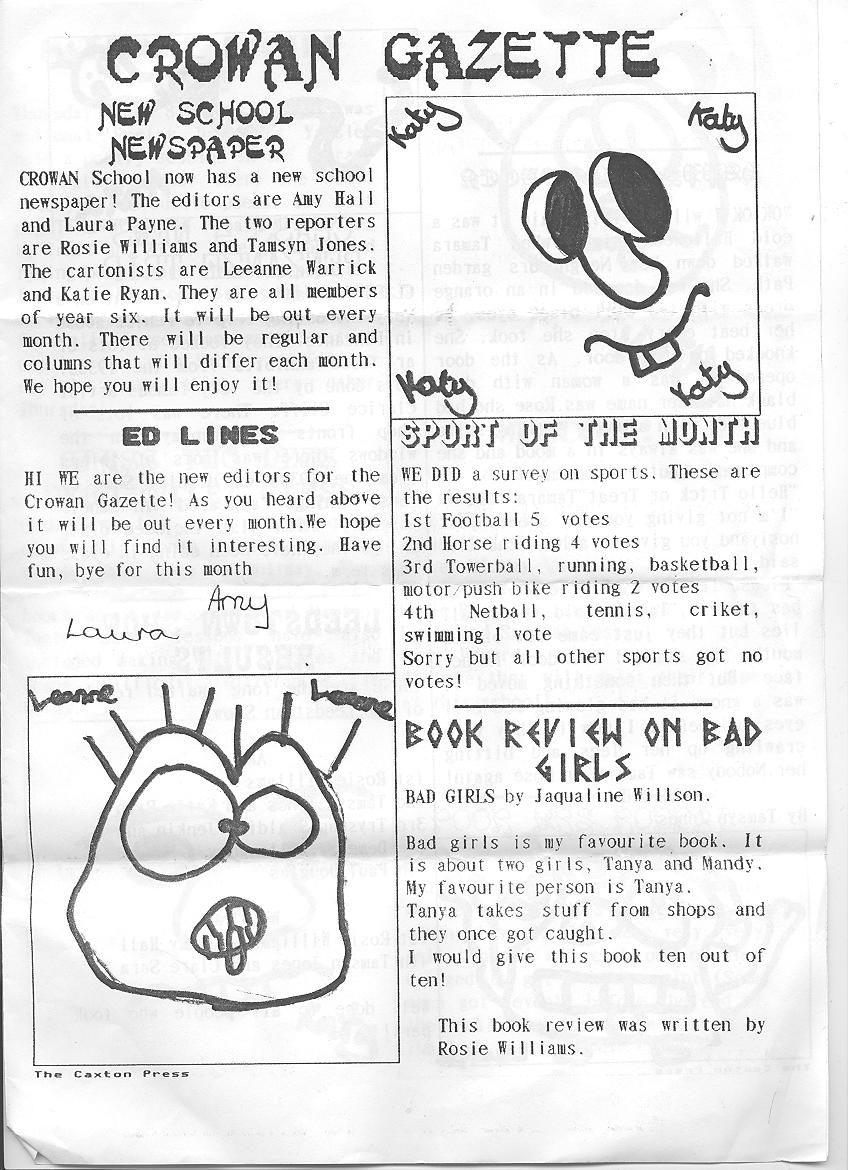
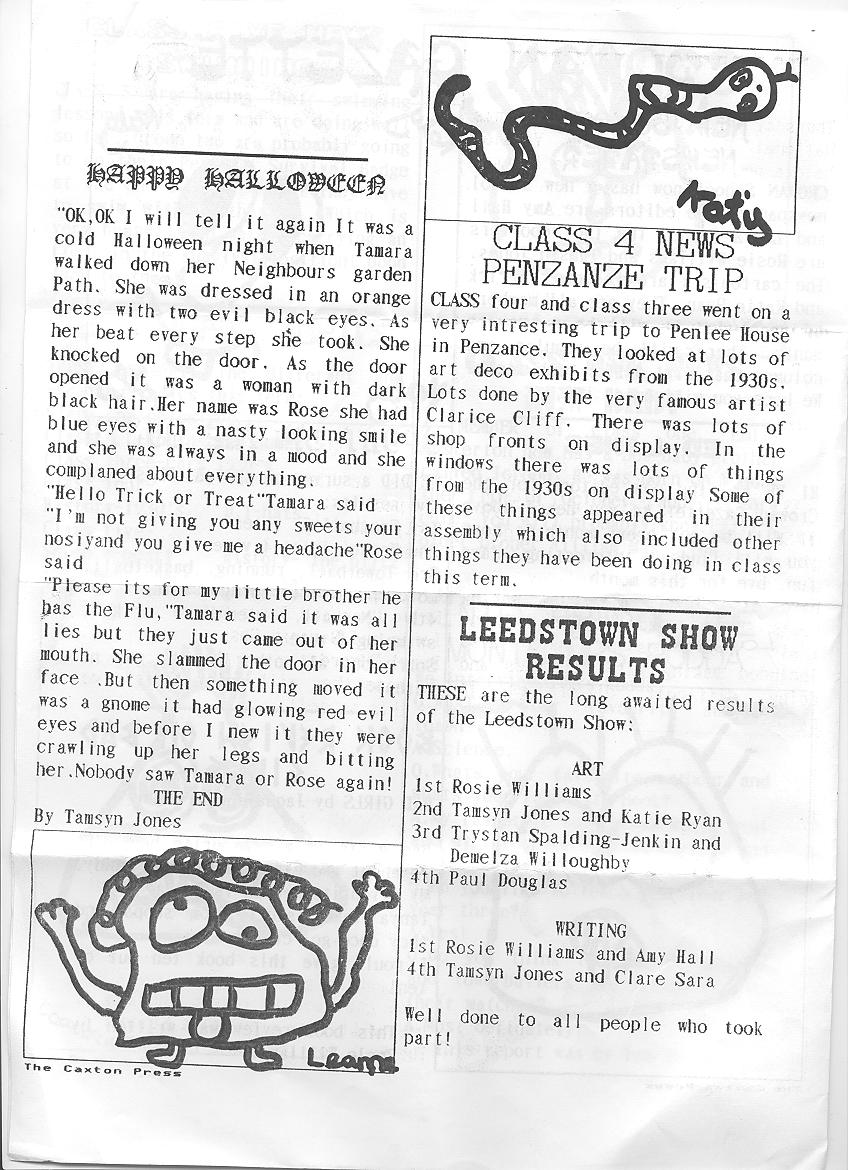
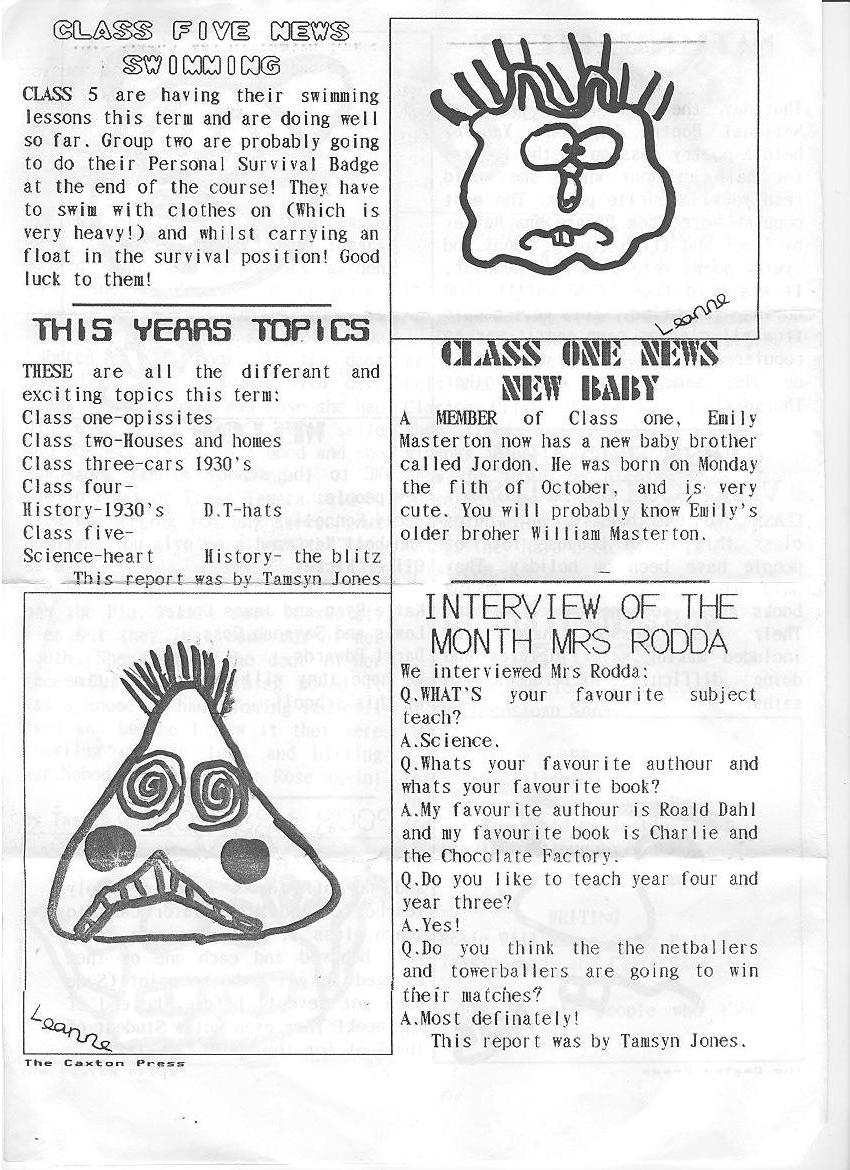
Recently I found this old Crowan Gazette at my parents’ house, which I helped to make while at Crowan School. It seems I was a co-editor. Also on the team was Tamsyn Jones, now one of my best friends. We must have been 10 or 11 at the time.

It says it was going to come out monthly but I don’t think we ever made another one! I can’t remember why. I love all the stuff like Leedstown Show Results, and Class 4’s trip to Penzance. Makes me a bit homesick for Cornwall.

LIVE // Y Niwl // Buffalo Bar // Cardiff // 28.01.12

First appeared on Never Enough Notes on Monday January 30 2012

In the mountains of Snowdonia you can imagine that fog could be an issue, after all Wales is not exactly known for its dry weather. Out of these mountains, three years ago, emerged from the mist a somewhat unlikely event.

Y Niwl (The Fog in English) are a surf rock band more akin to the west coast of America than the damp mountains of North Wales. Tonight they have travelled down south to one of Cardiff’s coolest venues, Buffalo Bar, to give an excited audience a dose of Shadows-esque guitar and surfy sounds, North Walian style.

Being an instrumental band can sometimes leave audiences feeling a little bit awkward. They can’t sing along and have to remember songs by melody and not what the singer is saying. For some, including myself, that can be a tall order. But Y Niwl show they don’t need lyrics; the depth of their rich sound speaks for itself, even after a storming set from support H. Hawkline. Y Niwl does very little vocalising in general, including in between the tracks, but the audience stay engaged.

Their self titled album was released in late 2010 and was nominated for last year’s Welsh Music Prize. Gruff Rhys won for his album Hotel Shampoo. Rhys is a friend of the band and they have toured America with him: “While a Welsh band going to America to play surf rock might seem a bit like taking coals to Newcastle, everyone over there was genuinely welcoming towards us,” guitarist Alun Evans told the Western Mail. Maybe you can teach your grandma to suck eggs.

Y Niwl play a neat 30 minute set at Buffalo, followed by an encore, and politely everything is done by 9.45pm with room for some Saturday night partying after the gig…or an early night.


No such thing as a free ride

First appeared on the alt.cardiff website on Thursday 14 December.

People on controversial work placements in Wales are working unpaid while unemployed. Critics see this as unfair but supporters argue getting experience is vital

Person working in Primark

In the ‘big society’ there is no place for those who don’t pull their weight, but in Wales there are now 137,000 people unemployed, a record amount.

Jobcentres arrange a variety of work experience to get people back into employment. One of these schemes is Mandatory Work Activity (MWA), where people undertake compulsory unpaid placements, or lose their benefits.

People can be referred to MWA at any time but they have usually been receiving jobseeker’s allowance (JSA) for at least 13 weeks. Placements are up to 30 hours a week, for four weeks.

Specialist providers such as A4e and Rehab JobFit are contracted to deliver placements through a variety of businesses and organisations. Since June 2011 Rehab JobFit has provided placements for 349 people in Wales. Over two thirds of these are in South East Wales, for organisations including YMCA and Wales Air Ambulance.

While some see MWA as work people should do for benefits, others see it as slave labour. Public Interest Lawyers have begun legal action against MWAdescribing it as “unlawful forced labour”.

Wasted skills?

It has been reported people doing MWA are forced to work in shops like Poundland and Primark, despite any other skills or experience. But some have managed to get placements suited to them.

Katie Simpson, 23 and living in Cardiff, has done two unpaid work placements during two years of unemployment. She said the first, compulsory and arranged through A4e, was for 13 weeks. She was expected to do 20 hours of work a week and five hours job hunting, but says she did get an extra £15 in JSA. She was also able to work for the Youth Offending Service where she already volunteered.

Bronwen Davis, also living in Cardiff, had been unemployed for 18 months when the jobcentre told her she had to do a work placement. She arranged her own with a music studio. “I don’t think a lot of people realise you can do that, but it can be a good opportunity to go and try something you’re interested in,” she said.

She said through running drumming workshops she learned more about working freelance and became more confident about self employment, which is her aim. “I did feel exploited though,” she said. “The company was getting hundreds of pounds a day and I wasn’t getting paid.”

Learning on the job

Katie’s second placement was with a claims management company and although it wasn’t compulsory she was told she had a strong chance of a job if she took it. “I was pretty reluctant to the idea, the placement was full-time. If I worked there I’d struggle to find any time to search for other positions,” she said.

It went well initially and Katie began to apply for jobs at the company but, “By week six the pressure of the job, with an income of £53 a week, started to take its toll and I took a couple of days off sick,” said Katie, who suffers from depression. When she returned she says she was given a disciplinary.

Katie was given the opportunity to sit on the team she had recently applied for a job with but the manager questioned her on her absences. “I knew this wasn’t strictly legal,” said Katie.

After three months another manager confessed to her that she had no chance of a job. “She said that for every application I had applied for there were more experienced individuals applying,” said Katie.

Katie doesn’t feel the placement was worth the work experience. “I had been talked down to nothing,” she said. “I felt incredibly depressed about my abilities. It’s an experience I would rather forget.”

Katie McCrory, media relations manager for A4e, said, “Lack of experience is one of the main reasons why people get turned down for jobs they apply for.”

Rob Fitt from Rehab JobFit, another provider, said MWA helps people, “establish the discipline and habits of working life, such as attending on time or regularly.” But many people have had previous employment.

Boycott Workfare campaign against compulsory, unpaid work experience. A spokesperson said MWA does not tackle unemployment successfully. “We haven’t received any news of people being offered full time paid positions,” he said.

He says they have no evidence people are being matched with relevant skills. “It seems where retail companies are concerned, people are being mandated to stack shelves,” said the spokesperson.

MWA can be seen as a way for businesses to get free labour at the expense of the state, and taking on paid staff, but some argue it is fair that people should have to work for their benefits. Employment minister, Chris Grayling,has said about work programmes: “No one should expect to be able to sit at home doing nothing.”

But with employment levels at a record high in Wales, and austerity measures taking hold, there is increased frustration that in the ‘big society’ hard work counts for nothing.

Interview with Jill Evans MEP

First appeared on alt.cardiff on Friday 11 November 2011.

Jill with Cymdeithas supporters

Politicians normally try and hide their law breaking from the public, but Jill Evans Member of the European Parliament (MEP) announced hers publicly when she stopped paying her TV licence in protest against cuts to the only Welsh language television channel, S4C.

“I’m standing side by side with the other people, the other 99 or a hundred, who’ve been refusing to pay their license fees,“ says Jill, outside court where she is appearing for the refusal. “I also feel that I’m doing it on behalf of the people who are not in the position themselves to take that sort of action because of their own circumstances.” She is adamant that this is her duty as a politician.

After a long wait a nervous looking Jill is called into courtroom two of Pontypridd Magistrates Court, joined by around 30 supporters. A large group are from Cymdeithas yr Iaith Gymraeg (the Welsh Language Society), here as a thank you for her support. The youngest supporter, who stays outside the courtroom, is a shy young girl in traditional Welsh dress.

Jill was still a student at Aberystwyth University when the original campaign to establish a Welsh language television channel took place. This also included the tactic of refusing to pay TV licences. “At that time students didn’t have televisions”, says Jill. “Thousands of people refused to pay, I remember the time very well.”

Although this is her first criminal offence, Jill has been an activist for many years and has campaigned with groups including Shelter and Greenpeace. She is currently chair of CND Cymru and took part in a blockade of Atomic Weapons Establishment Aldermaston with them in 2010.

It was when Jill got to university that she became involved in party politics and joined Plaid Cymru. She says this helped her combine her interests, “for me the whole language movement, the peace movement, the environmental movement, all the things that I’ve been involved in all came together.” She is now President of the party.

A day in court

Outside the court there is a murmur that proceedings will not be in Welsh, something a large group of Welsh language activists is bound to take seriously. But in the end they are translated into English, through headphones, to those who can’t speak Welsh.

Representing herself, dressed in a smart suit, Jill pleads guilty and gives a heartfelt speech explaining why she stopped paying. “This is an opportunity to show your support by not placing a fine,” she tells the magistrate. However, she is told that although her guilty plea was taken into account she will be fined £500 plus legal costs. Cries of “disgrace” come from supporters and one person shouts “stand up for the language and democracy”.

Back outside the court Jill looks relieved but resolute for the future. “I was given quite a heavy fine”, she says, “but of course when I begun this campaign, when I started this action I knew what the consequences would be. It was something I expected.”

But from now on Jill will be paying her television licence, along with other Cymdeithas yr Iaith Gymraeg campaigners, after an agreement was made between S4C and the BBC which guarantees funding for S4C until 2017. The focus is now a call for the devolution of broadcasting control to Wales, something Jill is also backing.

Language and identity

Jill sees S4C’s security as crucial to the survival of the Welsh language. “I live in the Rhondda and so many young children now go to Welsh language schools who come from non Welsh speaking homes. It’s so important that when they go home from school they hear the language at home.”

Born in the Rhondda in 1959, Jill also learnt Welsh as a second language and says a S4C is important for older people too. “It became such a symbol that it wasn’t just a TV channel. It’s been a real symbol of the whole campaign for the welsh language and its recognised as that around Europe as well.”

As an MEP since 1999 Jill also works to improve the status of Welsh across Europe. “It doesn’t yet have equality”, she explains, “but it is seen as a model by other minority languages as a very successful campaign.”

Jill’s approach to language is linked to her identity as a Welsh person but she doesn’t see that as exclusive. “I come from a family which has a very strong Welsh identity but I’m the only one who speaks Welsh. It’s not essential for being Welsh but I know that most people see the language as something that belongs to all of us whether we speak it or not and its something that has to be protected.”

New Blog: Take Root

I’ve started a new blog called Take Root all about grassroots campaigns and community projects in Cardiff. Hopefully it will grow to be a good place to find out about what’s going on in Cardiff and how to get involved as well as a place for discussion and interaction.

It’s early days still so any feedback welcome and if anyone wants to contribute in any way just let me know.


Unwatchable

First published on the Red Pepper website on Thursday 20 October 2011

It’s a sunny day and a small, blonde girl is picking flowers in her garden. The rest of her family, are arriving home from school, cleaning and washing the car. It’s a picture of middle England tranquillity, a large rural house and a close-knit family.

Within two minutes they are under attack leading to brutal rape, humiliation and murder, a regular occurrence in the Democratic Republic of Congo where nearly one woman a minute suffers some form of sexual abuse. The film uses an old campaigning trick to try to get Western audiences to take action on issues abroad. It asks what if this happened to someone you know? What if it happened to your family?

The film is definitely shocking, as the title suggests,  and Save The Congo and filmmakers Black Jack and Dark Fibre are hoping it will shock people into taking action. The film is attempting to highlight the link between violence and rape in the DRC and mobile phones. As the film is only available through the official site, they are careful to make sure there is always some context but the link between the story and mobile phones (explained by text at the end of the film) is not immediately clear without some digging around the website. It’s also arguable that making the film so graphic and not widely available will restrict how far their message spreads.

Hunger for DRC’s natural resources has had a negative effect on its citizens and like many countries in the global south natural resources have proved a curse instead of a blessing. The basis of the Unwatchable campaign is that minerals mined in the DRC have been financing the war which has seen over five million deaths in the country since 1998 and led to mass rape. DRC is rich in minerals such as tin, tantalum, tungsten that are all used in the manufacture of mobile phones as well as other electronic equipment such as games consoles.

These minerals pass through many hands before reaching the multinationals and money can get into violent hands. Over 90% of mines in eastern Congo are controlled by armed groups or sections of the army that have ‘gone solo’. As prices and demand rise there is more to bargain with; minerals are either bought directly from armed groups or from miners who pay taxes to warlords in order to mine. They are then sold on to traders who export the minerals to smelting companies for refining and ultimately to factories for manufacture. Unwatchable calls for more transparency in the process and an end to ‘blood minerals’.

Rape is used as a cheap and effective way to force populations to leave areas, or destroy communities and gain control of these lucrative minerals. While mass genocide would often provoke decisive action from the international community mass rape does not. Congo has now been named one of the most dangerous place in the world to be a woman.

Mobile phones are now seen as a necessity in the UK so the team behind the film are hoping that the connection of the industry to the events shown will galvanise people into action, seeing another away that their lives are affecting those elsewhere, and not for the better.

The main call to action, which comes at the end of the film, is a petition urging the EU to introduce legislation to stop mobile phone manufacturers buying conflict minerals as well as contacting their mobile phone manufacturer to demand they make sure they are not using blood minerals by publishing details of their supply chain.

The plot for Unwatchable is based on the true story of Masika and her family. Masika’s husband was mutilated and murdered, her daughters gang raped and Masika herself was raped over twenty times and forced to eat her husband’s dismembered penis. Masika was left unconscious and developed fistula. Traumatic fistula is often suffered by women in the DRC after violent rape. If it remains untreated it can lead to dangerous infection, incontinence, restriction of mobility and a nasty smell. These effects can lead to women, who have already undergone severe trauma, being ostracised from communities ans left immobile.

Maskia’s story is actually far more horrific than the one in the film and the video of her telling it on the website is incredibly powerful, coming directly from the person affected. Unwatchable is not the only recent film to highlight the issue of blood minerals. Blood In The Mobile is soon to be released which explores the relationship between minerals, violence and rape in DRC.

Although only just over six minutes long the production of Unwatchable is slick and you can tell it has some big Hollywood names behind it including composer David Arnold, cinematographer Michael Bonvillian and Mark Wolf. Film can be a good way to get an issue into people’s consciousness but there needs to be a clear link between calls to actions and horrific stories. Unless a film does this it doesn’t matter whose ‘eyes’ it is told through, people will still shrug it off as ‘just another tragedy’ they can’t do anything about.