First appeared on Never Enough Notes on June 18 2010
Released on June 21 2010 on Trash Aesthetics
Unfortunately, dictionaries are for words not phrases but if they were then the definition of Middle Of The Road (or MOR for fans of pretentious abbreviations) would be this album. Treecreeper are from Wendover, a sleepy village between Oxford and London. Wendover is somewhere, after a sneaky look on Google Streetview, I imagine weary travellers may have stopped back in the ‘olden days’, tethering their trusty horses outside the local pub as they travelled between the two cities. Juniper is a good theme to being trapped somewhere like this in a state of depression.
It could be argued that the re-released album should be compared to a long, lolloping summer’s afternoon; the tracks are all very thoughtful and self indulgent in length, the work of tortured souls who write poetry alone and lament what could have been.
The highlight, the only track which sounds like it was played with a band with some kind of enthusiasm for life, is the instrumental ‘Crossing’, a lovely summery affair but sadly only 50 seconds long.
‘November 23rd ‘ is a slightly redeeming feature finishing the album, a slightly different if mediocre song. It has a more filthy blues feel, like a smoky bar in a slow motion film scene. I imagine the protagonist is about to come face to face with his sweaty arch enemy or a couple is about to enrol in some up close and personal time as a band plays.
The rest of the album is seriously miserable but in a wanting to tear your hair out and throw the stereo out of the window way, not a self-indulgent have a good cry way. Everything has been levelled out to give one big drone of Americana on extra slow setting.
Maybe I just don’t get it.
3/10
First appeared on Never Enough Notes on May 22 2010
Released on 24.05.10 on Back Yard Recordings
Although most of the band met ten years ago, in high school, it’s taken them until now to release their first full album. Hyped since their self titled EP in 2008, this trendy electro outfit hail from Australia, but since being signed to a UK label have relocated to our shores.
Packed full of energy, “Sacrifice” is a prime example of the UK’s rapidly expanding indie electro scene, simmering with brooding attitude. Recorded in the depths of the Welsh countryside, it is easy to imagine some angry storms and dark drizzle going on while these tracks were penned.
The industry is all over female-fronted electro-pop at the moment, but Teenagersintokyo have a retro edge to their sound, similar to the new wave bands that came out of America in the 1970s, although tracks like “Long Walk Home” have a catchy 60s girl group vibe.
“Sacrifice” gets off to a sleepy start with “3046”, which could throw the less keen beans off the scent, but it is worth sticking through to “Robocat” which is more of a grabber and sets the tone for the rest of the album, full of angst with a strong beat, as is the single “End It Tonight”.
The band recorded with David Kosten, who has produced Bat For Lashes, and his stamp can definitely be heard on the album; the music is achingly cool. The band would be worth checking out live though if they manage to blow away any pretence and stuffiness but the mechanical sound is hard to escape on the recording; the drum machine sounding beats and perfectly formulated songs don’t have have that raw edginess that can be possible with this type of music. It just doesn’t sound dirty enough.
6/10
First appeared on Big Issue Cymru online on March 31 2010
Artes Mundi 4
National Museum Wales, Cardiff
3/5
As the old saying goes, ‘there’s nowt so queer as folk’. This year’s Artes Mundi short list reflects just that, from complex social and political struggle down to the tiny details and strange habits that make humans so intriguing.
The eight artists from around the world taking part in the fourth Artes Mundi competition are all vying for this year’s top honours. This year the works, which are judged in May, are all based around the theme of the human condition.
Fernando Bryce’s painstaking Indian ink copies of media, including newspaper articles and posters, cast their eye over history, laying bare the power of propaganda. It’s interesting to notice what and who is absent in these pictures; it’s clear the media gives only a snapshot, reflecting only the voices of those with the power to make themselves heard.
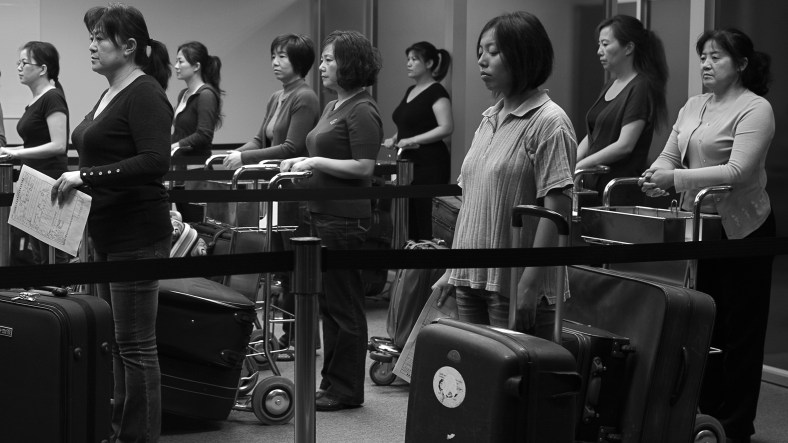
Chen Chieh-jen’s films about the position of Taiwan in the world are haunting. The stories, which are among the strongest works displayed this year, include the wives of Thai men from China and their struggle to be accepted as citizens. The imagery is dark and mesmerising – their tales told against a background of motionless women, silent in protest.
After the gloom, it is refreshing to step around the corner and lay eyes on Gulnara Kasmalieva and Muratbek Djumaliev’s lively and engaging photographs capturing the fall of Communism in Krygyzstan. The country’s Silk Road route connects it with China and other parts of Europe and North Africa and the images feature a light, vibrant and rich set of characters.
Yael Bartana’s work on the formation of Jewish identity, is striking, particularly his Mur i Wieża (Wall and Tower). A serene group of people, seemingly oblivious to the walls and barbed wire being constructed around them, are shown learning Hebrew to Polish translations in central Warsaw.
The beauty of Olga Chernysheva’s work, which explores modern Russia, lies in the tiny details of everyday moments. A young boy struggles with his uncomfortable cadet uniform while a teenager climbs a pole aided by the men below who are struggling to help him.
The amount of footage displayed this year means the exhibition can be time demanding. Meanwhile, some of the concepts shown are sometimes difficult to grasp – Adrian Paci’s work about Albanian weddings is elusive.
This year’s Artes Mundi shortlist collates a very diverse set of works, but sadly Africa and Oceania are not represented. An engaging collection, albeit one that sometimes masks its deeper meanings (exhibition runs until June 6th).
 Amy Hall